Alibaba Qwen Team Debuts Open-Source Qwen-Drive-1.0-4B Model
The new open-source model integrates vision-language capabilities with 3D perception and trajectory planning for autonomous driving systems.
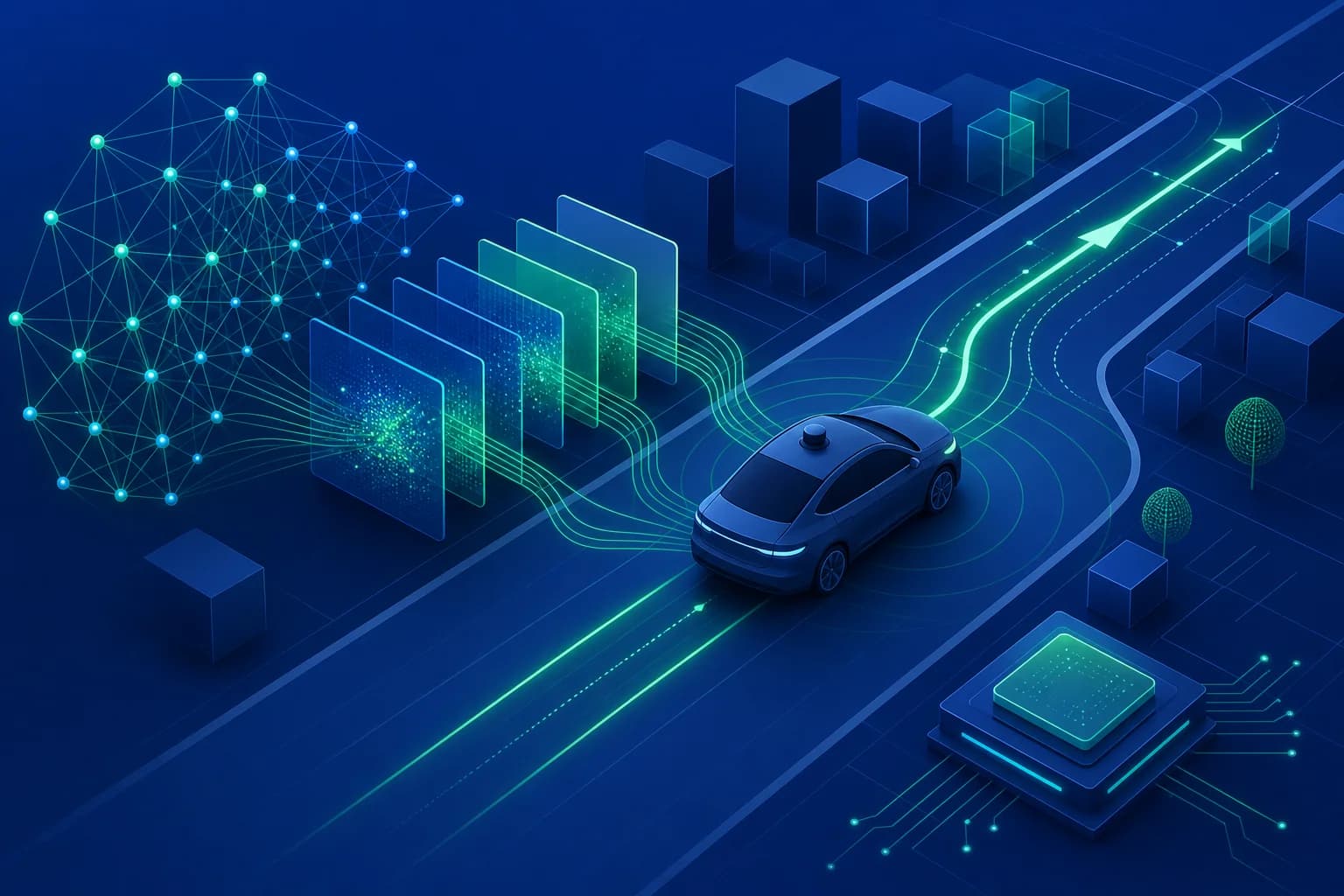
The Qwen team at Alibaba has introduced Qwen-Drive-1.0-4B, an open-source model designed to bridge the gap between high-level visual scene comprehension and low-level motion planning for autonomous vehicles. This release, developed in collaboration with researchers at the Huazhong University of Science and Technology, demonstrates how vision-language models can be adapted for real-time vehicular navigation.
At its core, the system utilizes the Qwen3.5-4B architecture as a foundational vision-language model. By maintaining this base, the model preserves its original capacity for complex visual question answering while extending its utility into specialized spatial domains.
The architecture incorporates dedicated components specifically engineered for 3D perception tasks. These modules allow the system to interpret depth and spatial relationships within the driving environment, which are critical for safe navigation.
Beyond perception, the model includes a distinct component for generating driving trajectories. This planning layer is responsible for translating environmental data into actionable movement commands for a vehicle.
The team provides two distinct versions of the planning component to support different research objectives. One version is trained via imitation learning, relying on existing driving datasets to mimic human-like decision-making patterns.
The second version undergoes further optimization through reinforcement learning techniques. This approach aims to improve the model’s performance in complex, dynamic scenarios where simple imitation might prove insufficient.
Both planning variants share the same underlying vision-language backbone. This consistency allows researchers to isolate the effects of different training methodologies on the final trajectory output.
Alibaba has released the project under the Apache 2.0 license, providing access to the source code, model weights, and demo data. This open-source strategy is intended to facilitate broader experimentation within the autonomous driving research community.
The integration of vision-language models into the autonomous driving stack represents a move toward more generalized, context-aware navigation systems. By leveraging the reasoning capabilities of large language models, developers can potentially improve how vehicles interpret ambiguous traffic situations or complex road signs.
The reliance on a 4B parameter model suggests a focus on computational efficiency. Smaller models are often more suitable for deployment on edge hardware, where latency and power consumption are primary constraints for real-time inference.
The use of reinforcement learning in the planning component highlights the ongoing challenge of balancing exploration and exploitation in high-stakes environments. Training models to optimize for safety and efficiency in unpredictable traffic requires managing the trade-off between reward signal sparsity and the need for robust generalization across diverse road conditions.
The release provides a sandbox for engineers to test how vision-language foundation models handle the specific demands of 3D spatial reasoning. Future iterations will likely focus on scaling these capabilities while maintaining the performance gains seen in this initial release.
Researchers and developers can now evaluate the model’s performance against existing benchmarks for trajectory generation. The availability of the full stack under an open license will likely lead to community-driven improvements and refinements in the coming months.
Deploying a 4B parameter model on edge hardware requires careful consideration of quantization and pruning strategies to maintain inference speed. Engineers must ensure that the vision-language backbone does not introduce excessive latency that would compromise the real-time requirements of autonomous vehicle control loops.
The modular nature of the Qwen-Drive-1.0-4B architecture allows for independent updates to the perception and planning layers. This separation of concerns simplifies the MLOps pipeline, enabling teams to iterate on trajectory generation models without retraining the entire vision-language foundation.
The project serves as a practical case study for integrating multimodal reasoning into hardware-constrained environments. By providing the model weights and training code, Alibaba enables the broader research community to stress-test the model’s decision-making logic against edge-case scenarios that are often missing from standard training datasets.