NVIDIA Deploys Alpamayo 2 Super for Autonomous Vehicle Reasoning
The new open-source model enhances AV decision-making by integrating high-level reasoning with 360-degree sensor fusion.
NVIDIA has officially released Alpamayo 2 Super, a new open-source reasoning model designed specifically to address complex decision-making challenges in autonomous vehicle (AV) operations. Announced in August 2026, this model expands the existing Alpamayo family by focusing on high-level cognitive tasks that extend beyond standard object detection and motion prediction.
The architecture of Alpamayo 2 Super is built upon the foundational NVIDIA Cosmos 3 Super Reasoner framework. Engineers have further refined the model through post-training reinforcement learning to improve its capability to interpret cause-and-effect relationships in dynamic traffic environments.
Deployment of the model is managed through the Hugging Face platform, where the Alpamayo family has already surpassed 500,000 cumulative downloads. The model is distributed under the OpenMDW-1.1 license, which is the Linux Foundation’s permissive standard for open AI model distributions.
This licensing structure is intended to facilitate broad adoption among automakers, truck manufacturers, and specialized AV suppliers. The terms explicitly permit fine-tuning, the creation of derivative models, and commercial redistribution, allowing organizations to integrate the model into proprietary data pipelines.
NVIDIA stated that the primary objective of this open-source release is to provide developers with greater control over their infrastructure and data. By maintaining ownership of their specialized models, companies can better align their safety workflows with specific fleet requirements and operational know-how.
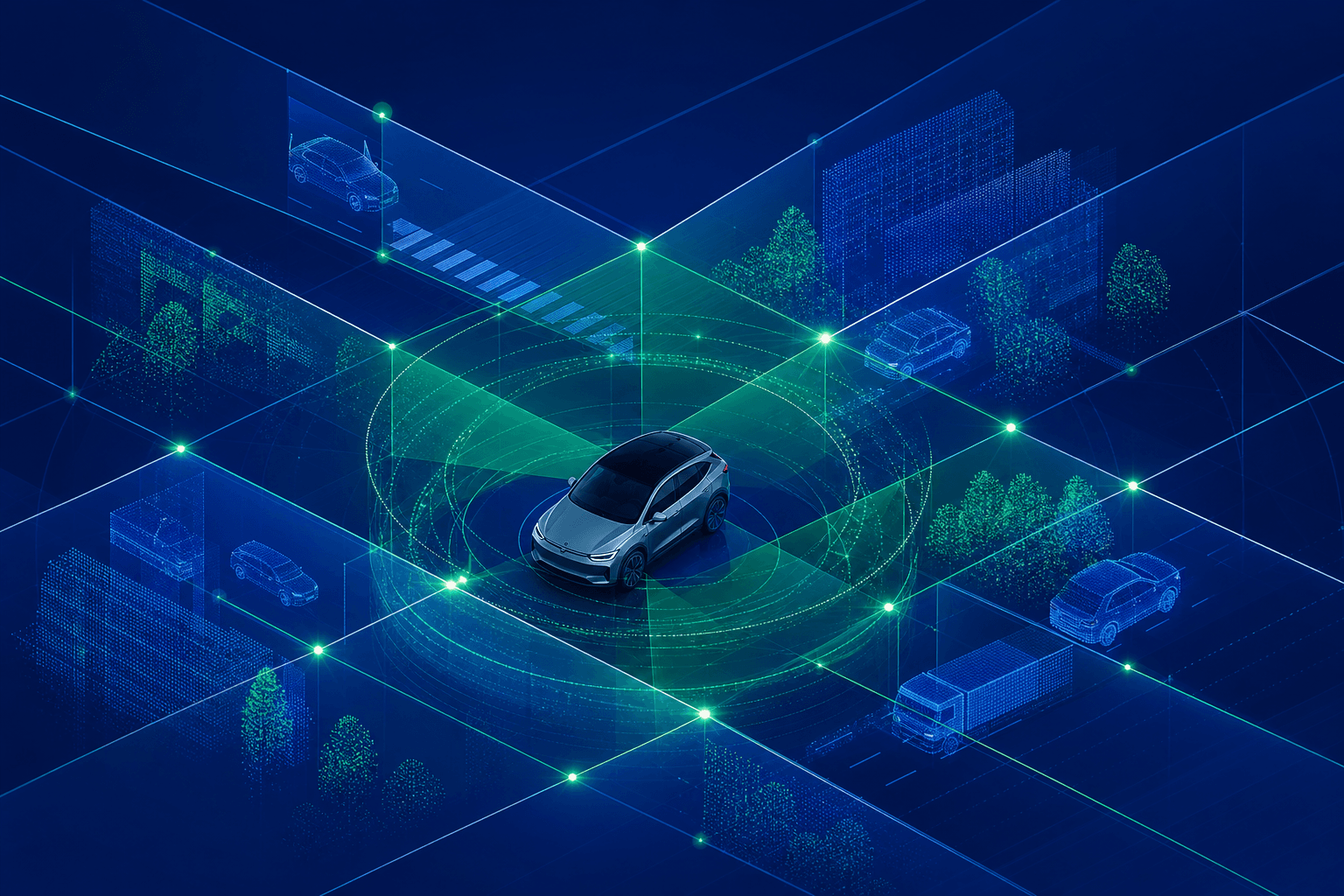
The model processes data from full-surround camera arrays to maintain 360-degree situational awareness. This fusion of front, side, and rear visual inputs allows the system to reason about complex maneuvers such as unprotected turns, lane changes, and multi-vehicle intersections.
Technical teams can utilize this 360-degree context to train models on rare, high-stakes scenarios that traditional perception systems often struggle to categorize. By providing a transparent reasoning layer, NVIDIA aims to reduce the reliance on monolithic end-to-end models that are notoriously difficult to debug in production environments.
Market data from the Linux Foundation indicates that permissive open-source licenses are becoming the preferred vehicle for collaborative AI development in safety-critical sectors. This shift suggests that developers are moving away from proprietary black-box solutions in favor of architectures that allow for rigorous internal inspection, validation, and transparent safety auditing.
The emphasis on reasoning over simple perception marks a shift in how AV stacks handle edge cases. Rather than relying solely on pattern matching, Alpamayo 2 Super attempts to model the intent of other road users and the logical consequences of the vehicle’s own actions.
This cognitive approach addresses the long-standing difficulty of anticipating rare, complex situations that are difficult to train for using standard datasets. By enabling vehicles to choose the right action in real time, the model provides a framework for safer and more comfortable path planning.
Future development cycles will likely focus on how these reasoning capabilities integrate with existing sensor fusion stacks. As the community continues to fine-tune the model on diverse driving datasets, the effectiveness of the underlying Cosmos 3 architecture will be tested across a wider variety of geographic and regulatory environments.
The long-term impact of this release depends on the rate at which tier-one suppliers and OEMs adopt the OpenMDW-1.1 framework. If the model becomes a standard component in the industry, it could significantly lower the barrier to entry for firms seeking to implement advanced cognitive features in their autonomous fleets.
Engineers integrating the model must now focus on MLOps pipelines that support rapid iteration and validation of these reasoning outputs. The ability to inspect the model’s logic during the training phase represents a significant improvement for teams managing large-scale, proprietary autonomous fleets.