Norwegian researchers deploy reinforcement learning for robotic food processing
A new robotic system utilizes deep reinforcement learning and tactile sensing to automate the delicate task of slicing and serving salmon.
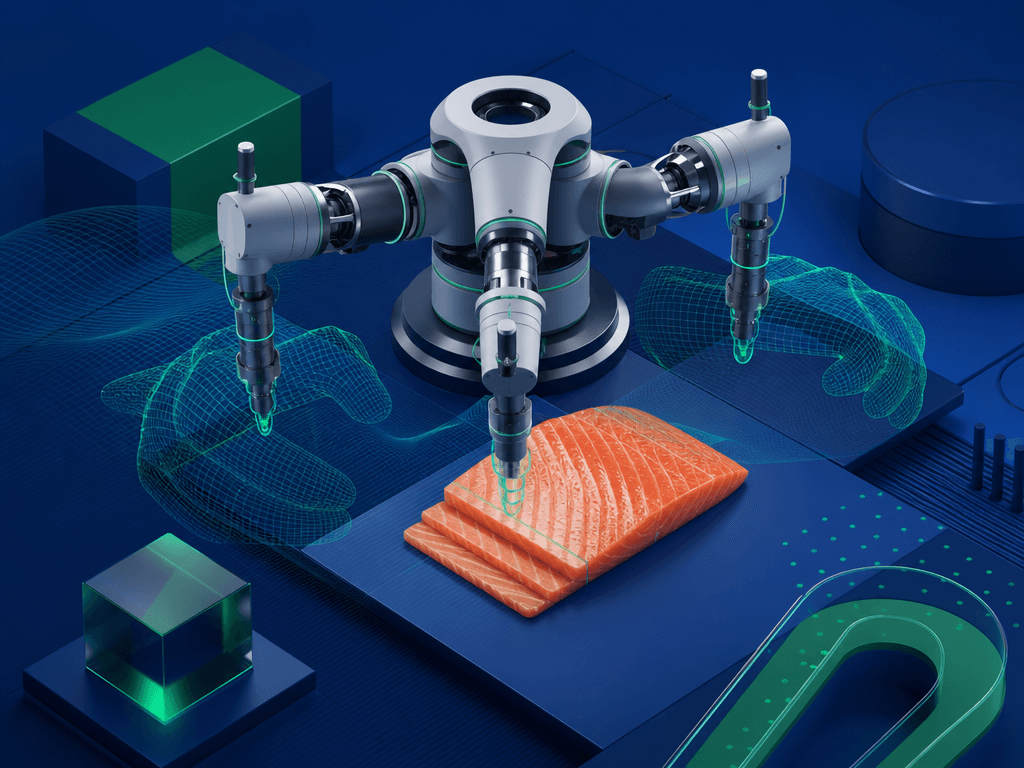
Researchers at the Norwegian University of Science and Technology have demonstrated a specialized robotic system capable of slicing and plating raw salmon, addressing significant challenges in the manipulation of soft, non-rigid objects. The project, detailed in the journal npj Robotics, highlights a shift toward autonomous systems that can handle delicate food items with precision previously reserved for rigid industrial components.
The system architecture relies on a three-armed configuration, with each limb assigned a distinct operational role. The first arm manages the stabilization and positioning of the salmon loin on the cutting surface, while the second arm executes the slicing motion using a standard chef’s knife. The third arm performs the final assembly, using chopsticks to retrieve finished slices and arrange them on a serving tray.
Lead researcher Sverre Herland and his team utilized deep reinforcement learning to train the robot within a virtual simulation environment. This approach allowed the system to iterate through thousands of movement patterns without requiring physical prototypes during the initial learning phase. The simulation-to-reality pipeline focused on optimizing the robot’s dexterity and decision-making processes for unpredictable material behavior.
The reinforcement learning model was structured to reward the agent for successful completion of the cutting task while penalizing erratic or inefficient movements. By defining a reward function that prioritized the contact consistency between the blade and the salmon, the researchers enabled the system to learn the optimal force profiles required for clean, uniform slices. This training methodology effectively bridged the gap between abstract simulation and the physical requirements of food preparation.
A critical technical component of the system is the integration of a GelSight tactile sensor on the knife-wielding arm. This sensor features a soft gel surface coupled with an embedded camera, providing the robot with real-time feedback regarding the contact point between the blade and the cutting board. The processing pipeline converts the visual deformation of the gel into precise force and position data, allowing the robot to detect the exact moment the blade makes contact with the board.
During empirical testing, the robot successfully processed 34 slices of salmon in a controlled environment. The system demonstrated a high success rate in retrieval, grasping 26 of the 28 slices that landed on the board, while also recovering six additional slices that adhered to the knife blade. Each complete cut cycle averaged 27.9 seconds, indicating a consistent performance metric for the automated task.
The significance of this research extends beyond culinary applications, as it provides a framework for handling deformable objects in automated manufacturing. Robotic systems have historically struggled with materials that lack structural rigidity, often resulting in failures when the object changes shape or orientation during processing. By combining tactile feedback with reinforcement learning, the team has created a more robust method for managing irregular biological materials.
The reliance on tactile sensors allows the robot to compensate for the lack of visual clarity when the knife is obscured by the salmon. This sensor-fusion approach enables the system to make real-time adjustments based on physical contact rather than relying solely on pre-programmed coordinates. Such capabilities are essential for environments where environmental variables cannot be fully controlled or predicted.
The project serves as a case study for the effectiveness of simulation-based training in complex physical tasks. As reinforcement learning techniques continue to mature, the gap between virtual training and real-world execution is expected to narrow further. Continued development will determine if these methods can scale to more complex, high-speed industrial environments where precision is paramount.
Future iterations of this technology may focus on reducing the cycle time and improving the success rate of the grasping mechanism. Researchers are likely to explore how these reinforcement learning models can be adapted for other soft-material tasks, such as textile handling or medical robotics. The ability to perform delicate, non-rigid manipulation remains a primary hurdle in the advancement of general-purpose robotics.