Avride deploys cloud-based vision-language models for robotic safety
The company is integrating heavy foundation models as a semantic safety net to help delivery robots interpret complex, high-stakes urban environments.
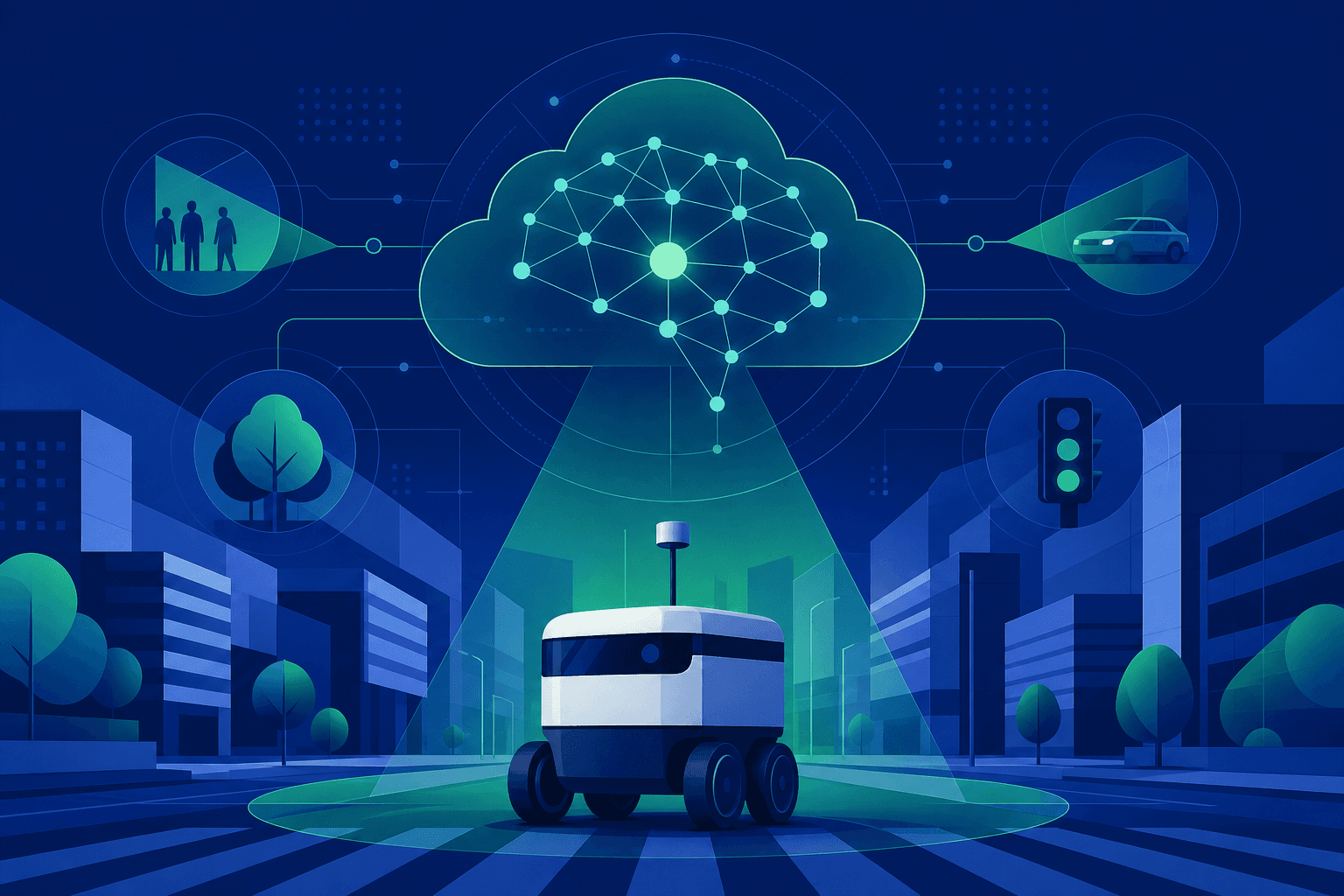
Avride has integrated cloud-based vision-language models (VLMs) into its autonomous delivery fleet to provide a semantic safety layer that exceeds the capabilities of traditional onboard perception stacks. While the company’s sidewalk robots already process complex sensor data locally to navigate urban environments, the deployment of these heavy foundation models addresses the challenge of interpreting high-stakes, non-standard environmental contexts.
The onboard perception system remains responsible for primary navigation, utilizing local neural networks to detect agents such as pedestrians, cyclists, and emergency vehicles. However, standard object detection often fails to distinguish between routine urban activity and sensitive situations, such as active crime scenes or unmapped roadwork. Avride engineers identified that a holistic understanding of scene semantics is required to prevent robots from entering restricted or hazardous areas.
To manage this, the company implemented a cloud-based VLM watcher that operates as an automated early warning system rather than a real-time control mechanism. The robot transmits anonymized camera snapshots to the cloud every few seconds, ensuring that privacy-sensitive data like faces and license plates are obscured before transmission. This architecture avoids the latency issues associated with relying on cloud connectivity for critical driving decisions.
In the cloud, the VLM processes these visual snapshots against a set of predefined semantic prompts designed to flag unusual or high-stakes scenarios. When the model identifies a critical tag, it triggers an immediate alert for the remote assistance team. A human operator then reviews the live feed to ensure the robot yields to emergency responders or navigates around restricted zones appropriately.
The infrastructure is designed as an open, plug-and-play architecture, allowing Avride to continuously benchmark and swap in the most accurate semantic interpreters as the AI field advances. This approach reflects a shift from the company’s legacy use of similar pipelines, which were previously employed exclusively for data mining and labeling rare scenarios. By repurposing this pipeline for live operations, the firm has established a direct data path between advanced semantic reasoning and human-in-the-loop oversight.
The system relies on a continuous ingestion loop where the VLM acts as a filter for incoming visual data. By assigning specific high-stakes tags to scenes, the model effectively reduces the noise for human operators, who only intervene when the semantic interpreter flags a potential safety violation. This workflow ensures that the remote assistance team focuses exclusively on complex, non-trivial scenarios that require human judgment, utilizing the VLM to perform high-dimensional feature extraction that standard bounding-box detectors cannot achieve.
Roman Nefedov, head of autonomous delivery at Avride, notes that this cloud-to-remote-assistance framework is a pragmatic response to the limitations of current edge computing. The system effectively manages the trade-off between the computational intensity of large models and the necessity of maintaining low-latency autonomous navigation on the sidewalk. This layered approach ensures that robots remain responsive to complex human environments while maintaining strict safety protocols.
The reliance on cloud-based semantic analysis provides a necessary safety net, but it also highlights the current boundaries of onboard compute capacity. The integration of VLMs into the production pipeline serves as a critical stopgap while the industry waits for further optimization of foundation models. As these models become more compact, the engineering team intends to migrate this deep semantic layer directly onto the robot’s onboard hardware.
The migration path toward edge-based semantic processing involves optimizing model weights and pruning architectures to fit within the thermal and power constraints of local robotics hardware. Achieving this transition would enable fully autonomous decision-making that is independent of network connectivity. Until such hardware advancements materialize, the current cloud-based architecture remains the primary mechanism for ensuring that delivery robots operate as responsible participants in complex city environments. Future iterations will likely focus on reducing the computational overhead of these models to facilitate more high-fidelity, localized reasoning.