RLCore Deploys Constrained Reinforcement Learning for Industrial Infrastructure
The new RLTune platform integrates directly into existing utility control stacks to provide real-time, adaptive process optimization without requiring digital twins.
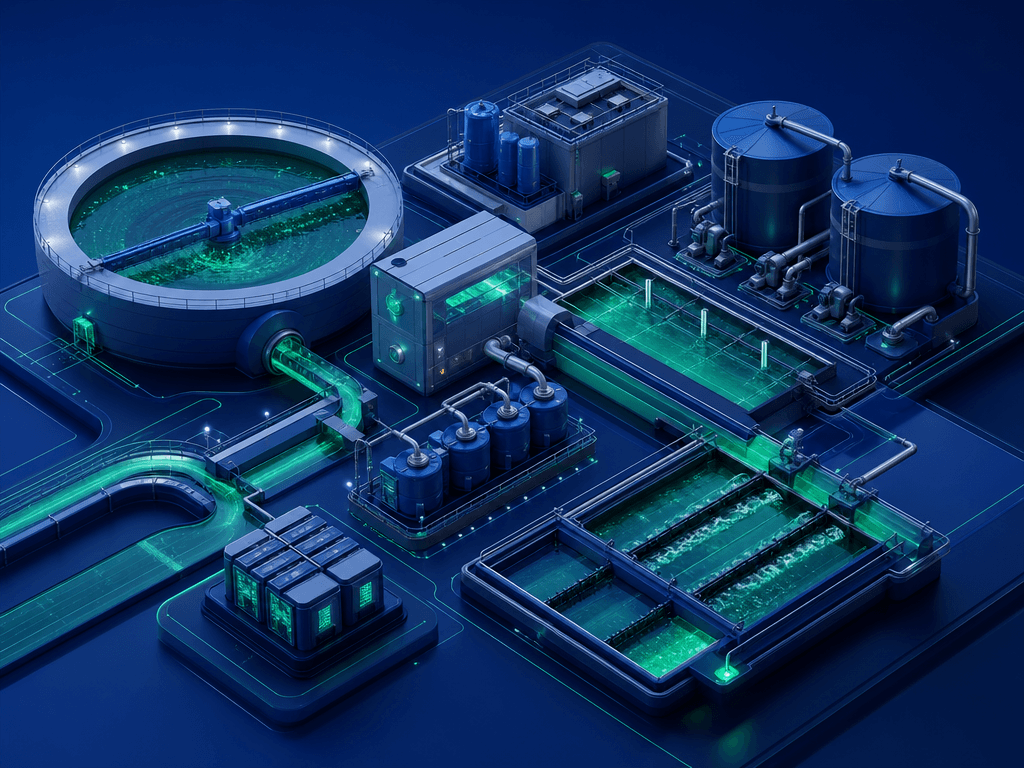
RLCore officially introduced its RLTune platform at the American Water Works Association’s ACE26 conference on June 22, 2026, marking a transition toward real-time autonomous optimization in industrial control systems. The software functions as an adaptive intelligence layer, integrating directly with existing control stacks to manage water and wastewater treatment processes through constrained reinforcement learning.
Industrial facilities historically rely on static control models that struggle to account for nonlinear variables such as influent fluctuations, equipment degradation, and shifting energy costs. RLTune addresses these operational gaps by continuously learning from live data streams to adjust process parameters in real time. The system operates alongside traditional programmable logic controllers and distributed control systems to meet operator-defined key performance indicators.
Data from initial deployments indicate significant efficiency gains, with utilities reporting reductions in chemical and energy consumption ranging between 15% and 25%. Shelley Terry, General Manager of Infrastructure at Drayton Valley, noted that the integration has increased operational stability and reduced the manual burden on staff. The platform achieved these results while maintaining existing infrastructure, avoiding the capital-intensive overhauls often associated with industrial automation upgrades.
Frank Mannarino, Senior Vice President at EPCOR Water Services, emphasized that the RLCore approach aligns with the practical realities of utility management. The system provides a mechanism for advanced control that integrates into established workflows rather than replacing them. This deployment model focuses on operational responsiveness, allowing facilities to maintain performance standards despite environmental variability.
The technical architecture of RLTune distinguishes itself by eliminating the requirement for digital twins or complex physics-based simulations. Instead, the platform utilizes a constrained form of reinforcement learning that learns directly from the specific environment of the plant. This design choice reduces implementation timelines and lowers the barrier to entry for facilities lacking extensive modeling resources.
Operators retain oversight through a system of configurable guardrails that allow for incremental autonomy. The software includes full transparency features and provides instant override capabilities, ensuring that human operators remain the final authority in decision-making. Data logging functions allow for the quantification of operational patterns without impacting the underlying control loops.
Security remains a primary design constraint, with the platform functioning on-premise to ensure sensitive operational data does not leave the facility. The system maintains vendor-agnostic connectivity through the OPC-UA standard, facilitating compatibility with a wide array of SCADA and IoT gateways. This architecture allows for deployment in environments where data sovereignty and cybersecurity are critical requirements.
Ganesh Rao, CEO and Co-Founder of RLCore, described the platform as a shift away from static control paradigms that have dominated the sector for decades. The reliance on continuous learning enables systems to adapt to disturbances without requiring periodic manual retuning. This capability represents a move toward what the company defines as Real-Time Autonomous Optimization.
Martha White, CTO and Co-Founder of RLCore, highlighted that recent advancements in reinforcement learning have made continuous, real-world adaptation practical for industrial applications. By moving beyond monitoring and recommendation, the system actively manages process variables to improve outcomes. The focus remains on optimizing performance within the constraints of existing, live operating environments.
The underlying reinforcement learning model functions by mapping state observations to control actions while adhering to strict safety boundaries defined by the operators. By utilizing a constrained optimization framework, the agent avoids high-risk control decisions that could compromise plant stability or regulatory compliance. This approach ensures that the learning process remains bounded within safe operating envelopes, even when the agent encounters novel environmental conditions or sensor noise.
Future adoption of RLTune will likely depend on the platform’s ability to demonstrate long-term reliability across diverse utility settings. As RLCore continues its presence at the ACE26 conference, industry observers will monitor how these autonomous systems handle edge cases and extreme process disturbances. The success of this deployment could signal a broader trend toward integrating machine learning into the foundational layers of critical infrastructure.