India Consolidates Retail AI Infrastructure as GCC Talent Demand Surges
India has emerged as the primary global hub for retail innovation, with 180 GCCs now outperforming international peers in AI and engineering capacity.
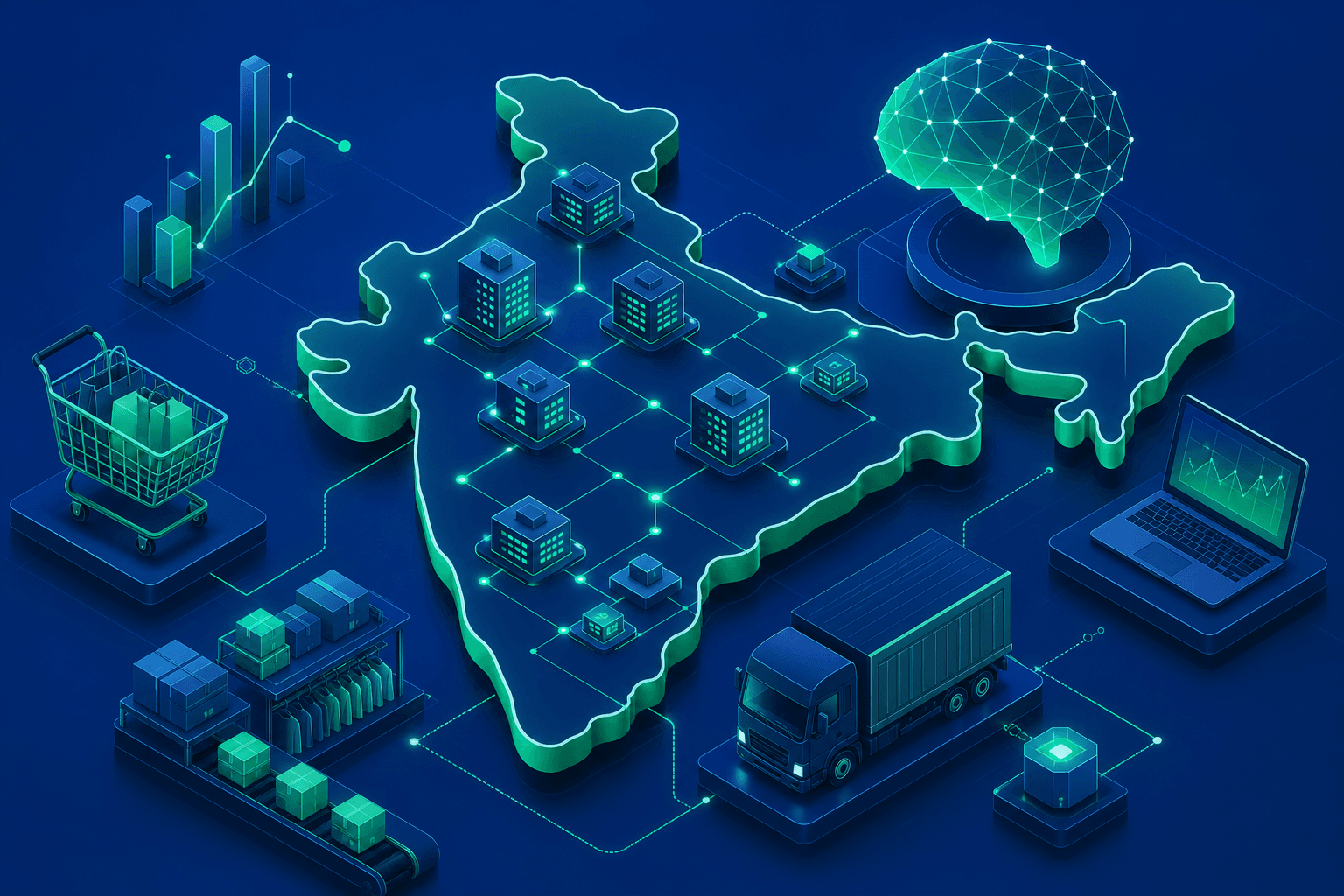
India has solidified its position as the primary global hub for retail innovation, hosting 180 Retail Global Capability Centers (GCCs) that employ over 270,000 professionals. This concentrated ecosystem now exceeds the combined capacity of the next five international peer markets, including Poland, Germany, Mexico, and the Philippines, according to a report titled The Retail Pivot: Consumer GCCs Find Their India Edge by TeamLease Digital.
The shift represents a fundamental transition from legacy back-office support to sophisticated engineering mandates centered on artificial intelligence and digital transformation. Retail and eCommerce operations currently command 55.8% of the total GCC workforce, with food and beverage and personal care sectors filling out the remainder of the ecosystem. Bengaluru remains the primary anchor for this activity, housing 84,000 professionals, while Delhi NCR and Hyderabad follow with 66,000 and 45,000 employees respectively.
Hiring velocity accelerated significantly between 2024 and 2025, resulting in more than 52,000 new job opportunities within a single year. Projections indicate that technology, customer success, and supply chain functions will account for 80% of total hiring demand by 2028. Engineering requirements alone are expected to climb from 25,140 in 2025 to 41,000 within three years as organizations prioritize automated infrastructure.
Data and analytics roles are experiencing a sharp rebound, with demand growth reaching 82% in 2025 following a period of displacement caused by early generative AI adoption. Technical requirements are shifting rapidly toward specialized domains including LLM engineering, MLOps, and vector database management. Conversely, traditional rule-based analytics and manual quality assurance roles are facing a 42% displacement rate as enterprises automate legacy workflows.
The integration of LLMs into retail operations requires a significant shift in infrastructure, moving from standard data processing to complex vector database management and retrieval-augmented generation pipelines. MLOps teams are increasingly tasked with managing the lifecycle of these models, ensuring that inference latency remains within acceptable bounds for real-time customer interactions. This technical evolution necessitates a workforce capable of handling both the underlying model architecture and the deployment at scale across global retail networks.
Despite the rapid expansion of the workforce, AI specialist penetration remains low, accounting for fewer than one in 20 employees across the sector. The current AI workforce penetration stands at 4.8%, with forecasts suggesting a rise to 7.2% by 2026. Neeti Sharma, CEO of TeamLease Digital, emphasized that the organizations poised to lead the next five years are those prioritizing their AI mandate immediately rather than waiting for future budget cycles.
A significant bottleneck exists at the senior level, where only 320 professionals possess eight or more years of dedicated AI experience across the entire 180-center ecosystem. This scarcity has triggered intense competition for talent, with 90.2% of new hires in the past year sourced from outside the retail sector, primarily from IT services and product companies. Compensation structures are increasingly decoupling from tenure, with AI and machine learning roles commanding a two-fold premium over broader market averages.
The concentration of AI talent in Bengaluru, which holds 54% of the national pool, creates significant operational risk for global retailers. Leaders are now evaluating secondary hubs like Hyderabad, Pune, and Chennai to mitigate geographic bottlenecks and address high attrition rates. These talent constraints suggest that the next phase of growth will depend on the ability of GCCs to build internal senior benches rather than relying solely on external hiring.
The transition toward intelligent automation requires a strategic recalibration of early-career talent development to curb high first-year churn. As only a fraction of the top 50 GCCs currently maintain active generative AI teams, the immediate focus for the next 12 months will be on formalizing product ownership and scaling MLOps capabilities. Future performance will likely be determined by how effectively these centers integrate specialized AI engineering into their existing retail supply chain and customer experience frameworks.