Precision Livestock Farming Leverages Edge AI and Computer Vision
Modern livestock management integrates multimodal sensor arrays and edge computing to automate health monitoring and herd tracking.
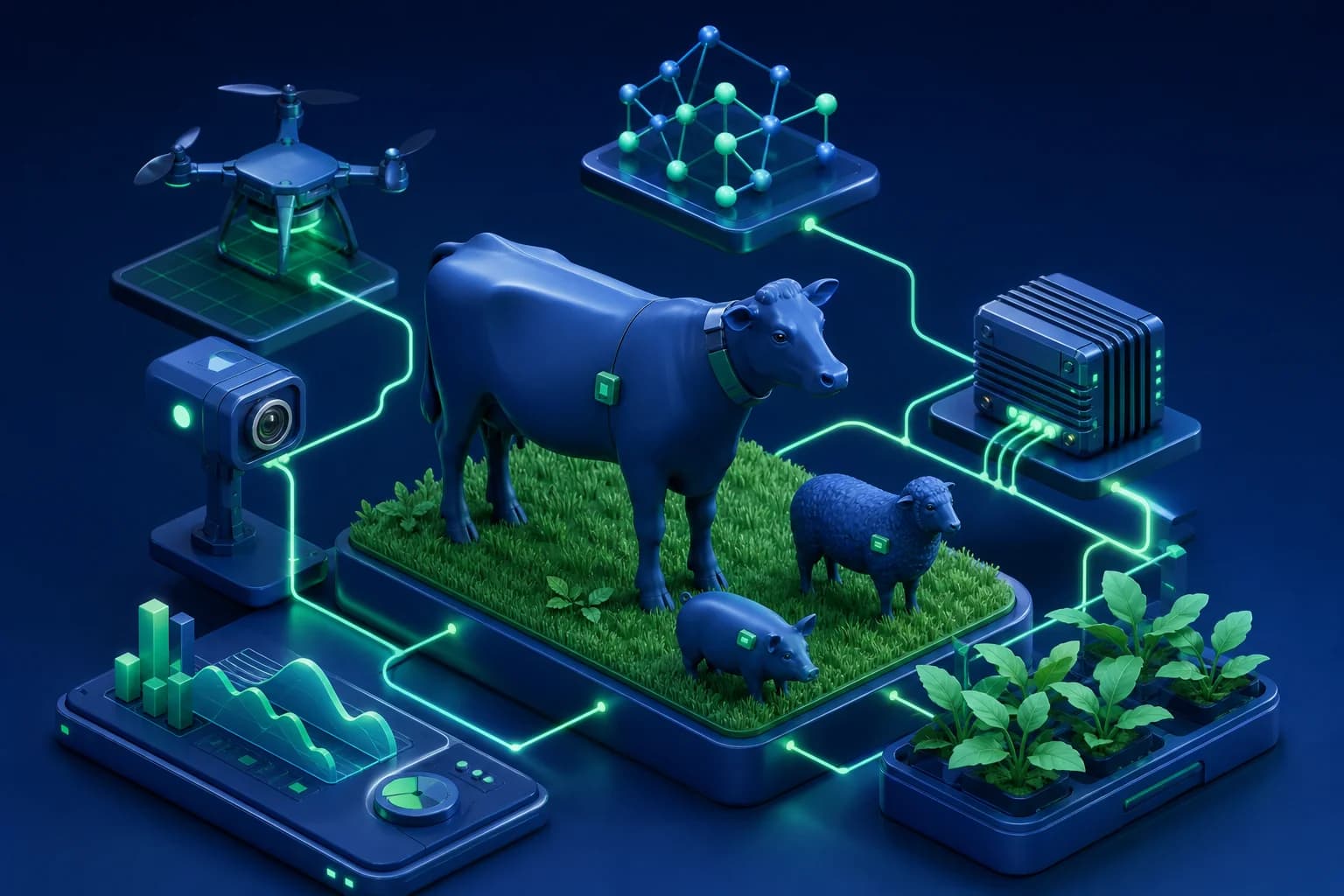
The integration of machine learning into livestock management has evolved from simple wearable sensors to complex, multimodal perception systems. Engineers now treat agricultural environments as high-stakes stress tests for applied artificial intelligence, requiring robust solutions for messy data, intermittent connectivity, and non-cooperative subjects.
Traditional livestock monitoring relies on manual observation, which faces significant scaling limitations as skilled labor costs rise. Human-led inspections are inherently intermittent and reactive, often failing to identify health issues until clinical symptoms manifest. Automated systems address these gaps by providing continuous, individual-level monitoring that identifies deviations in behavior or physical condition long before they become visible to the human eye.
Wearable technology remains the most mature segment of this stack, utilizing triaxial accelerometers to classify animal behavior through motion analysis. These devices translate raw data into actionable insights regarding rumination, grazing, and resting patterns. Recent advancements have introduced closed-loop autonomy by combining GPS tracking with active feedback mechanisms, such as the solar-powered collars developed by Halter.
Halter demonstrated the commercial viability of this approach in March 2026, securing a $220 million Series E funding round at a $2 billion valuation. The company reports that its virtual fencing technology now supports over 2,000 operations across New Zealand, Australia, and the United States. By leveraging direct-to-satellite connectivity, these edge devices eliminate the need for traditional on-ranch infrastructure while enabling precise herd management through audio and vibration cues.
Computer vision serves as a primary tool for automating labor-intensive tasks like body condition scoring and lameness detection in barn environments. A systematic review published in the journal Sensors in July 2026 confirms that deep learning architectures, including YOLO-family detectors and transformer-based models, frequently exceed 90% accuracy in these domains. These systems rely on extracting skeletal keypoints to analyze gait and posture, effectively applying pose estimation techniques to non-human subjects.
Metric depth foundation models, such as the Depth Anything and Metric3D series, have significantly improved the feasibility of single-camera weight estimation. These models allow for the recovery of metric volume from 2D images, overcoming the challenges of occlusions and variable animal positioning. While dedicated 3D sensors remain common in commercial setups, the shift toward monocular depth estimation suggests a trend toward lower-cost, high-performance hardware configurations that do not require specialized lidar equipment.
Acoustic monitoring provides a third modality, particularly effective for identifying respiratory disease in high-density environments like pig barns. Systems such as SoundTalks, offered by Boehringer Ingelheim, utilize always-on audio processing to isolate specific distress signals from ambient noise. By comparing daily cough frequencies against baseline metrics, these platforms provide quantitative health scores that enable early veterinary intervention.
The convergence of these technologies highlights a shift toward data-driven agriculture where the animal acts as an edge device in a larger network. Success in this field depends on the ability to perform inference in resource-constrained environments where cloud connectivity is unreliable. Engineers must account for the specific challenges of edge deployment, such as power management and the need for local model quantization to maintain real-time performance on low-power hardware without sacrificing inference accuracy.
Data scientists working in this sector prioritize model optimization to ensure that vision pipelines function effectively on low-power embedded systems. This requires balancing the computational demands of large transformer architectures with the physical limitations of hardware deployed in remote, dusty, or high-humidity environments. By utilizing techniques like pruning and knowledge distillation, developers can deploy sophisticated models directly at the point of capture.
The industry is now moving toward fully integrated systems that combine visual, acoustic, and inertial data into unified health dashboards. As these multimodal pipelines mature, the focus will shift from simple detection to predictive modeling, allowing for the preemptive treatment of livestock before productivity losses occur. This transition allows producers to replace manual, periodic checks with continuous, automated oversight of biological assets.