Tencent Cloud Debuts DataBuddy to Automate Agent-Native Data Workflows
The new workbench integrates intelligent agents into data engineering and analytics pipelines to accelerate model deployment and improve query accuracy.
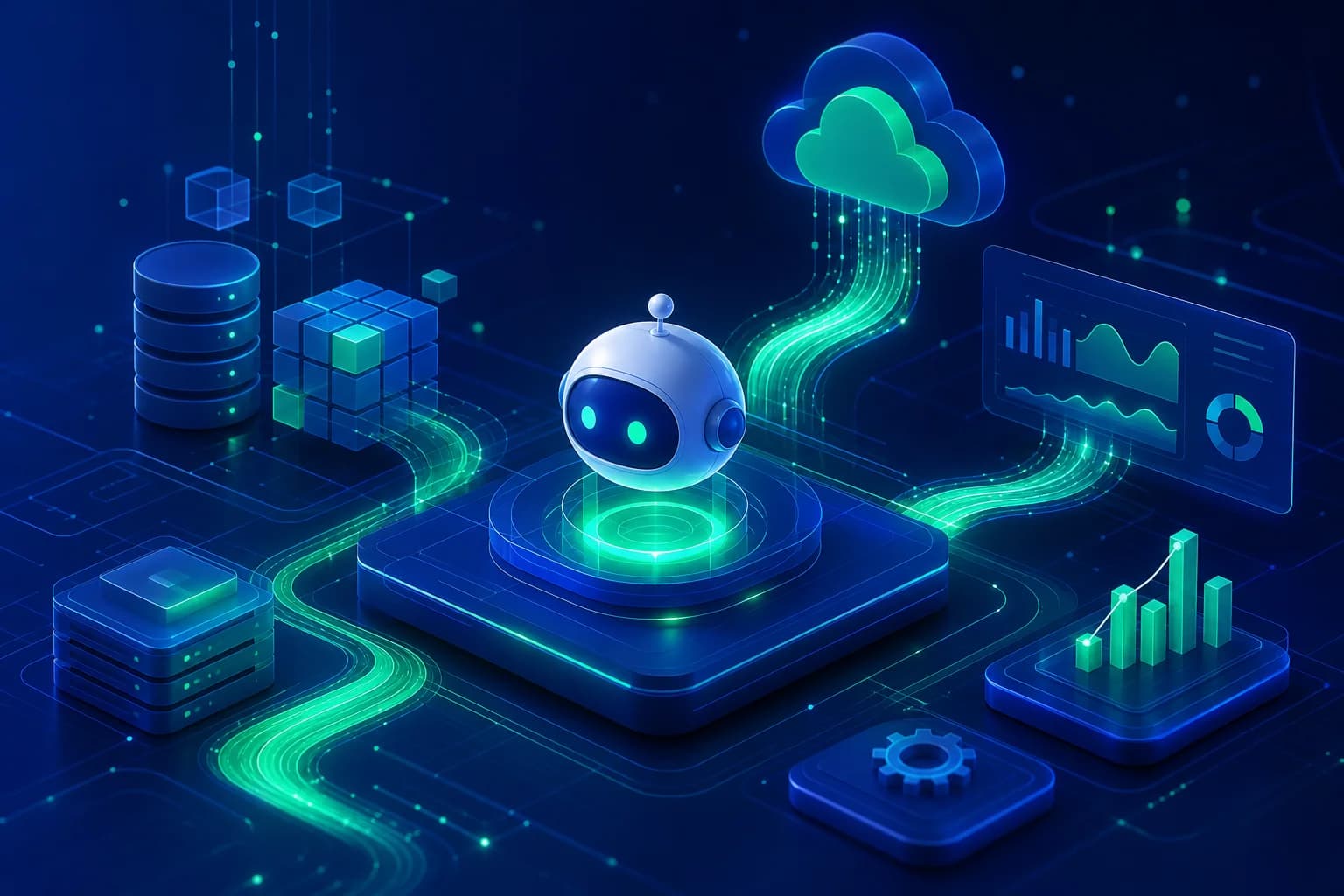
Tencent Cloud officially launched Tencent Cloud DataBuddy on September 22, 2026, introducing a fully managed, agent-native workbench designed to unify data engineering, governance, analytics, and science. This platform functions as the third assistant-class product in the company’s portfolio, joining existing tools like Tencent CodeBuddy and WorkBuddy to streamline enterprise-scale AI operations.
The architecture centers on four primary agent-driven scenarios, including automated end-to-end pipeline delivery with self-healing capabilities for data engineering. Data governance features provide warehouse-wide health checks that monitor metadata, lineage, quality, and security protocols across the entire stack.
Data analytics functions through conversational interfaces that perform automated root-cause analysis on complex datasets. For data science teams, the platform consolidates data and AI foundations to accelerate model deployment cycles from 30 days down to 7 days.
The system relies on Unity Semantics, a business semantic layer that reportedly achieves 95.9% analysis accuracy by moving beyond standard Natural Language to SQL (NL2SQL) methods, which the company benchmarks at 83.5% accuracy. This semantic layer maps raw data schemas to business-level concepts, ensuring that agents interpret complex queries with higher fidelity than traditional text-to-code models.
An integrated Agent Runtime layer ensures that enterprise deployments remain within a governed, auditable framework with strict data controls. This runtime environment enforces policy-based access, allowing administrators to audit agent decisions and trace data lineage in real-time, which is essential for compliance in regulated sectors like finance and healthcare.
Operational efficiency is managed through OneOps, a unified layer that combines DataOps, MLOps, and AIOps into a single interface. By consolidating these traditionally siloed disciplines, the platform reduces the overhead associated with managing disparate toolchains for data preparation and model training.
Tencent Cloud reports that these combined capabilities deliver between 5x and 10x efficiency gains for data teams managing complex infrastructure. The reduction in model deployment timelines from 30 days to 7 days indicates that the platform’s value lies in its ability to shorten the feedback loop between data ingestion and model inference.
Deployment flexibility allows enterprises to connect existing OLAP engines without requiring data movement, or alternatively, to adopt a unified storage and compute model. This approach aims to help organizations maintain control over data sovereignty while utilizing the platform’s analytical tools.
The product is currently available in China, Thailand, South Korea, and Indonesia, with expansion plans targeting markets in Europe, North America, and South America. These regional rollouts reflect a broader strategy to standardize AI-agent workflows across diverse global regulatory environments.
The shift toward agent-native workbenches represents a transition in MLOps, where the focus moves from manual pipeline management to autonomous, agent-driven orchestration. By embedding business logic directly into the agents, Tencent Cloud addresses the technical challenge of context loss that occurs when generic LLM-based tools lack access to enterprise-specific metadata.
The emphasis on a business semantic layer suggests that the primary bottleneck for enterprise AI adoption remains the translation of domain-specific business rules into machine-executable code. Providing a governed runtime environment addresses the critical requirement for auditability, a major hurdle for large-scale institutions seeking to deploy automated data agents.
This acceleration is likely to influence how enterprises prioritize their MLOps investments, favoring platforms that offer integrated, self-healing pipelines over fragmented toolsets. Future adoption will depend on how effectively the platform handles edge cases in data quality and the ease with which existing legacy systems can integrate with the OneOps layer.
Industry observers will monitor the expansion into Western markets to determine if the 95.9% accuracy claim holds up against varied, non-standardized enterprise data schemas. The ability of these agents to maintain performance across heterogeneous environments will be the ultimate test for this architecture and its long-term viability in the global market.