NVIDIA, Oklo, Los Alamos Team on Nuclear AI Data Centers
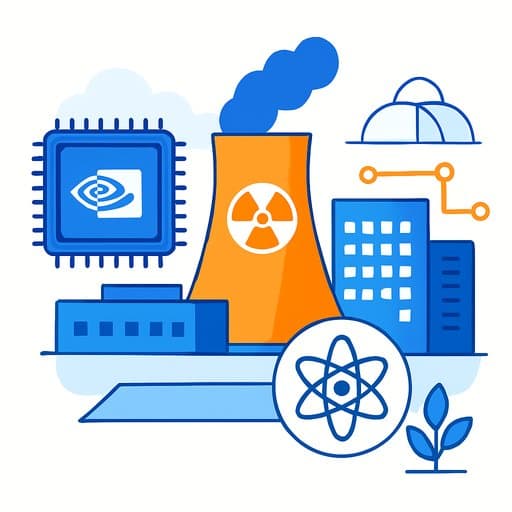
Facing AI’s unprecedented energy hunger, NVIDIA, Oklo, and Los Alamos are building data centers powered by advanced small modular nuclear reactors. This strategic alliance aims to create a self-sustaining energy future for AI, even using AI to develop its own nuclear fuel.
The relentless hunger of artificial intelligence, particularly the vast neural networks powering large language models and advanced training workloads, has quietly emerged as one of the most significant constraints on its future.
While the computational prowess of modern graphics processing units (GPUs) has driven remarkable breakthroughs, the sheer energy required to sustain these digital behemoths is staggering, placing immense strain on existing power grids and raising serious questions about sustainability.
It is against this backdrop of escalating demand that an unusual yet profoundly strategic alliance has coalesced, promising to fuse the cutting edge of AI with the formidable, often misunderstood, power of the atom.
NVIDIA, the semiconductor giant synonymous with accelerated computing and the backbone of much of today’s AI infrastructure, has forged a pivotal partnership with Oklo, a developer specializing in advanced small modular nuclear reactors (SMRs), and the venerable Los Alamos National Laboratory.
Their collective ambition is nothing short of revolutionary: to construct data centers specifically powered by these compact nuclear plants, creating an autonomous, high-assurance energy ecosystem tailored for the insatiable demands of AI.
This endeavor is not merely about powering data centers; it is a critical component of the federal government’s Genesis Mission, an initiative designed to expedite the deployment of robust power sources for the nation’s burgeoning digital infrastructure.
At its core, this collaboration addresses a fundamental paradox: AI, a technology heralded for its potential to solve humanity’s grand challenges, simultaneously creates an energy problem of unprecedented scale.
Traditional data centers often rely on fossil fuel-derived electricity, contributing to carbon emissions, or draw heavily from already stressed grids, leading to stability concerns and a looming energy crunch.
Nuclear power, by contrast, offers a carbon-free, high-density energy alternative that can operate continuously, independent of weather patterns that often plague renewable sources like solar and wind.
Oklo’s SMR designs represent a new generation of nuclear technology, characterized by their smaller footprint, enhanced safety features, and modular construction, which theoretically allows for faster deployment and greater flexibility compared to traditional, gigawatt-scale nuclear plants.
The synergy within this partnership extends beyond a simple energy supply agreement.
NVIDIA’s advanced AI tools are not just consuming nuclear power; they are actively being deployed to accelerate the very research and development of the nuclear fuels that will power Oklo’s reactors.
Under the federal Genesis Mission, NVIDIA’s accelerated computing capabilities will drive sophisticated inference models.
These models are crucial for validating and manufacturing plutonium-bearing fuels – the very heart of Oklo’s innovative Pluto reactor.
By applying AI to complex physics and chemistry-based simulations, the partners aim to dramatically cut the time and cost associated with traditional materials science research, traditionally a decades-long endeavor.
This closed-loop innovation—AI powering nuclear research which in turn powers AI—underscores a profound leap in technological interdependence.
Furthermore, the collaboration will delve into critical studies focused on grid reliability, redundancy, and stabilization.
The goal is to ensure that these nuclear-powered AI data centers can not only operate with an unblemished, consistent power supply but also deftly manage the rapid and often unpredictable fluctuations in demand that characterize intensive AI workloads.
The stability provided by a dedicated, on-site nuclear reactor offers a significant advantage over drawing power from a shared, volatile grid.
For IT and development professionals, this partnership signals a profound shift in infrastructure planning.
The decision-making matrix for data center strategies will increasingly encompass not just hardware specifications and cooling solutions, but also the fundamental source and reliability of energy.
Organizations evaluating the future of their compute resources must now monitor how advanced nuclear power might impact the cost, availability, and sustainability of the processing power they need.
The pervasive CUDA software ecosystem, NVIDIA’s proprietary platform for accelerated computing, will remain central, but its physical underpinning is set to evolve dramatically.
Beyond the immediate implications for AI and IT, this alliance casts a long shadow over broader energy policy and infrastructure development.
Should the Oklo-NVIDIA model prove successful, it could catalyze a renaissance for nuclear power, positioning SMRs as a viable, attractive solution for other energy-intensive industries and potentially as a decentralized power source for communities.
It offers a powerful counter-narrative to the intermittency challenges of renewables and the carbon footprint of fossil fuels, particularly as global energy demands continue to surge.
However, the path forward is not without its complexities.
The deployment of nuclear technology, even advanced SMRs, invariably confronts a labyrinth of regulatory hurdles, stringent safety protocols, and often, public skepticism rooted in historical perceptions.
Engineering challenges, though mitigated by modular design, will still require meticulous execution.
Yet, the sheer scale of AI’s energy appetite suggests that such audacious solutions may not merely be desirable, but inevitable.
The partnership between NVIDIA, Oklo, and Los Alamos represents more than just a technological convergence; it embodies a strategic gambit to secure the energy future of artificial intelligence, potentially unlocking new frontiers of discovery that were previously constrained by the limits of power.
The silent hum of a nuclear reactor may soon become the heartbeat of the digital age, powering the very intelligence that reshapes our world.